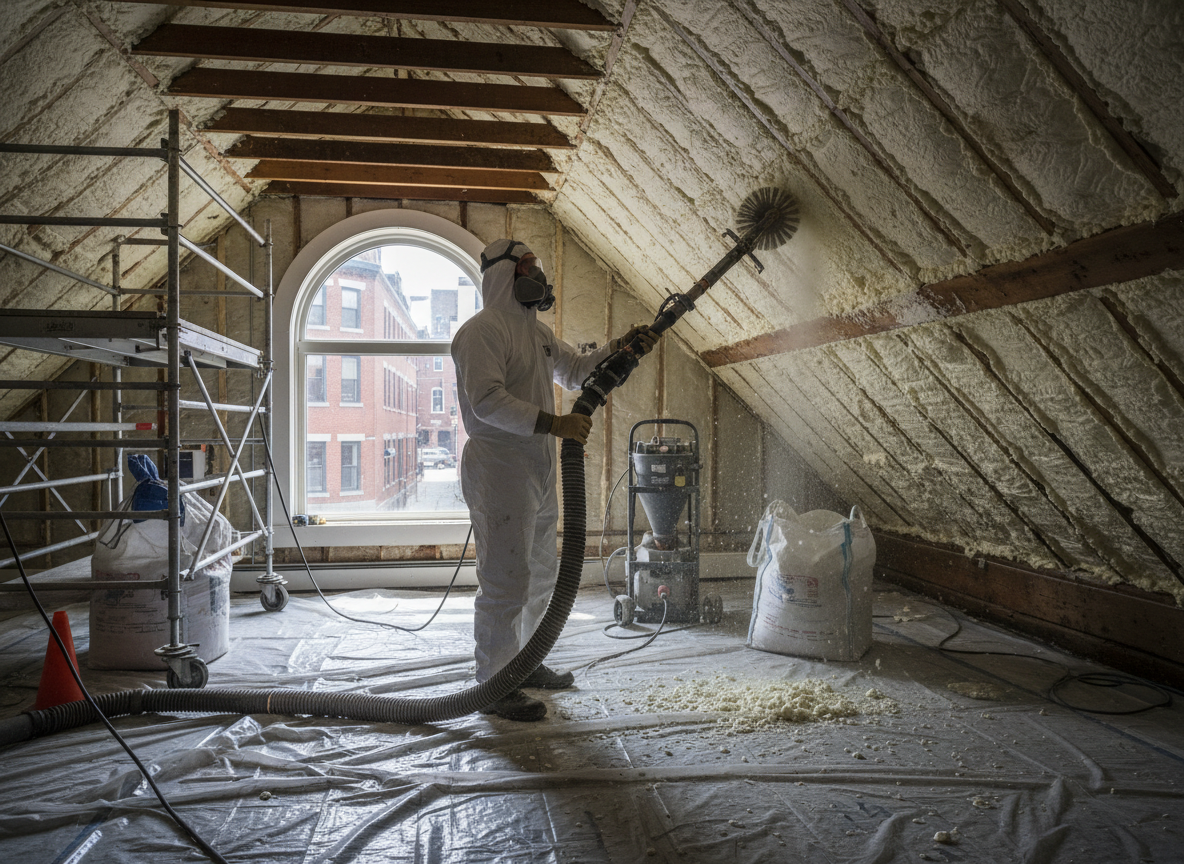
Boston Lincolnshire properties often feature Victorian and Edwardian terraced housing with pitched roofs that received spray foam insulation decades ago. Over time the closed-cell foam traps moisture against rafters in the region's high water table and frequent winter rainfall, leading to timber decay and reduced ventilation. Removal requires careful cutting and vacuum extraction to avoid disturbing original lath and plaster ceilings below while preserving the roof structure that has already settled over a century of fenland ground movement.
Homeowners in Boston town centre and surrounding villages like Wyberton and Kirton commonly discover the foam has blocked eaves and ridge vents, creating condensation pools that drip onto insulation and joists. The work involves sectioning the foam into manageable pieces, bagging it for disposal, and checking for hidden damp patches that the foam concealed. Lincolnshire's damp winters mean any remaining residue must be removed completely or it will reabsorb moisture within a single season and restart the cycle of rot.
Access through small loft hatches in narrow terraced houses demands sectional disassembly of equipment and dust containment sheeting that reaches the full height of the roof void. After extraction, the original roof timbers are inspected for softening and the space is left ventilated so air can circulate freely again. Properties near the River Witham or in lower-lying parts of the town require extra attention to water staining that indicates previous flooding events the foam had hidden from view.
Technician insight
In Boston the thing that catches most people out with loft spray foam removal is the high water table and fenland damp that lets the foam trap condensation against rafters for years before any sign shows downstairs. Older terraced roofs here have already moved with the ground so aggressive pulling can crack aged timbers that a careful sectional cut avoids.
Foam Removal in a Boston Terraced Loft
Homeowner noticed ceiling stains after heavy winter rain. We found closed-cell foam blocking all eaves vents and holding moisture against 100-year-old rafters in a South Street property. Sections were cut out under containment and the space was left fully ventilated. Condensation stopped within weeks and no further timber damage occurred.
How it works
- 1
Initial Loft Inspection
Assess foam depth, roof condition and access points in Boston properties.
- 2
Containment Setup
Install sheeting and negative pressure to protect living spaces below.
- 3
Foam Sectioning and Extraction
Cut and remove foam in controlled sections using specialist tools.
- 4
Timber Inspection and Cleanup
Check rafters for moisture damage then vacuum all residue.
- 5
Ventilation Restoration
Ensure eaves and ridge vents are clear before leaving the site.
Pricing
Upfront quotes based on loft size, foam thickness and access difficulty; no fixed rates published.