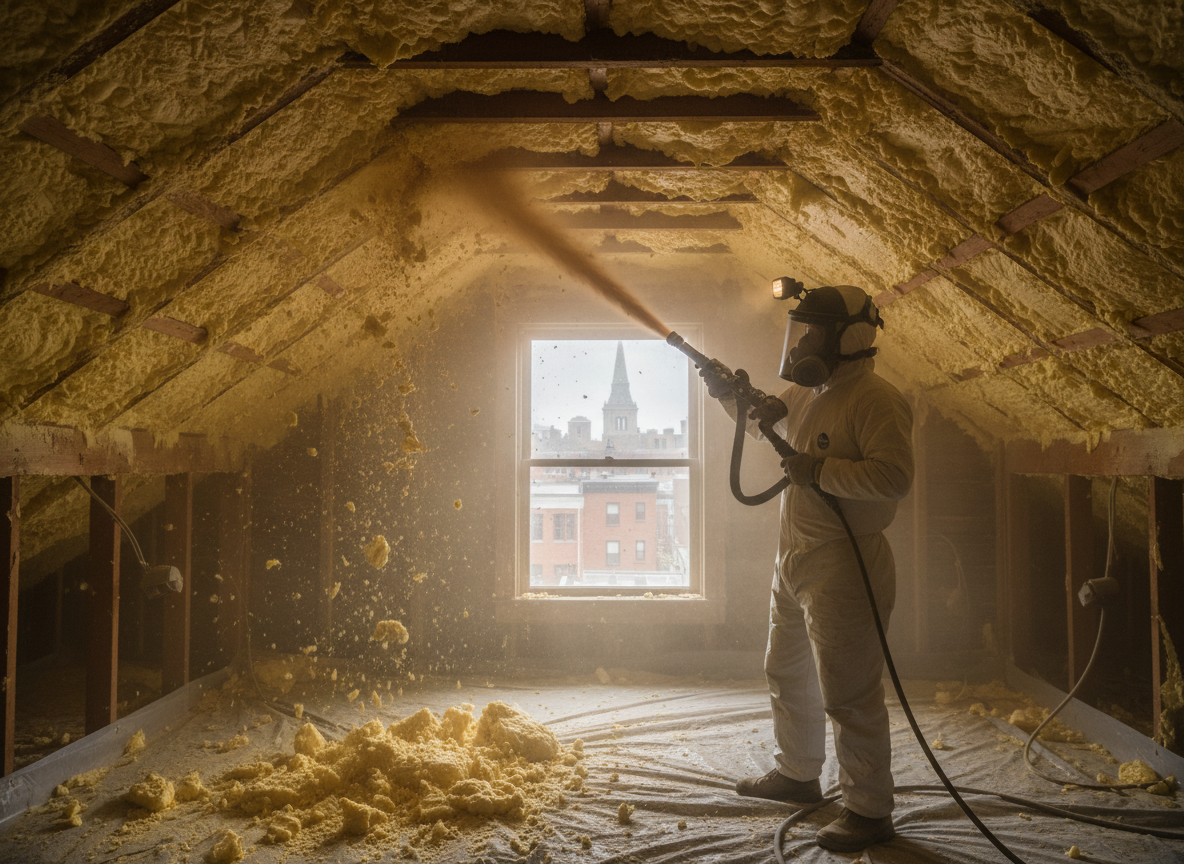
Sand blasting removes rigid spray foam from roof voids and wall cavities common in Boston's older brick terraces and post-war semis. The method uses controlled abrasive media to strip polyurethane without damaging underlying timber or masonry. Lincolnshire's frequent damp winters leave foam saturated, increasing dust load and requiring sealed containment to protect adjacent rooms. Operators must account for narrow loft hatches typical in Victorian stock around the town centre, which limits equipment size and extends setup time. Proper negative air pressure and HEPA filtration prevent silica and foam particles from migrating into living spaces.
Edge cases arise when foam has been applied over electrical cables or pipework in properties near the River Witham. Abrasive particles can nick insulation or create pinhole leaks if pressure is not calibrated precisely. In these situations technicians reduce nozzle velocity and work in smaller sections, often extending the job by half a day. Local building control sometimes requires notification when insulation is removed from cavity walls, particularly in conservation areas around Boston market place. Homeowners should expect a full inspection before work begins to identify hidden services and confirm substrate condition.
After blasting, residual dust must be vacuumed from every joint and rafter. Incomplete extraction leaves a fine film that later affects new insulation adhesion or causes respiratory issues. Disposal follows Environment Agency rules for construction waste; foam fragments are bagged on site and taken to licensed facilities rather than general landfill. Crews working from the South Street base can reach most Boston addresses within thirty minutes, allowing same-day response when water ingress has already started to degrade the foam.
Technician insight
In Boston the thing that catches most people out with sand blasting spray foam insulation removal is the narrow loft hatches and brittle lath-and-plaster ceilings in terraces built before 1910; once the foam is gone the plaster often needs extra support we did not budget for at first glance.
Foam removal after roof leak near South Square
Water had soaked the spray foam in a 1930s semi close to the market place. Inspection showed saturated material bridging rafters and trapping moisture against the ceiling. Sand blasting cleared the foam in controlled passes while negative air kept dust out of the bedrooms below. New insulation was fitted the following week with no further damp issues reported.
How it works
- 1
Site Inspection
Assess foam depth, access points, and hidden services in the specific Boston property.
- 2
Containment Setup
Install sealed sheeting and negative air machines to control dust throughout the void.
- 3
Abrasive Removal
Apply calibrated sand blasting to strip foam from rafters and masonry without substrate damage.
- 4
Cleanup and Disposal
HEPA vacuum all surfaces then bag and remove waste for licensed disposal.
Pricing
Upfront quotes provided after inspection; final cost depends on access difficulty, foam thickness and property age.