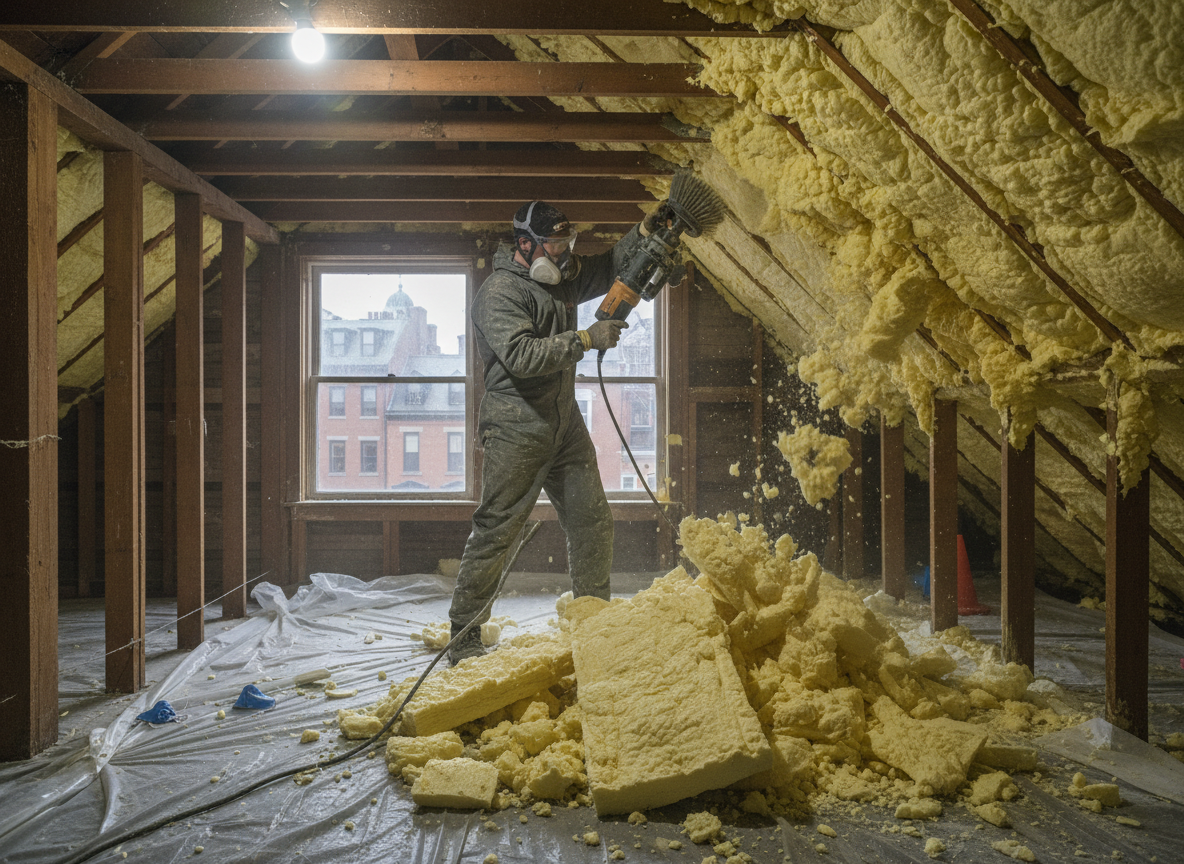
Closed cell spray foam bonds tightly to timber joists and lath in Boston's Victorian terraces and 1930s semis, often trapping moisture against the roof deck during Lincolnshire's frequent winter rainfall. Removal requires careful mechanical scraping followed by solvent softening to avoid damaging original roof timbers that have already absorbed years of fenland humidity. Homeowners in areas like Skirbeck and Wyberton commonly discover the foam was applied over existing felt that has since rotted, creating hidden water ingress points that must be addressed before any new insulation is considered.
The process starts with negative-pressure containment to prevent dust and foam particles from migrating into living spaces below, a critical step in compact Boston properties where lofts sit directly above bedrooms. Technicians cut the foam into manageable sections rather than pulling it whole, reducing the risk of pulling plaster ceilings or disturbing asbestos-containing artex common in Lincolnshire homes built before 1980. After extraction, surfaces are cleaned with specialist neutralisers to remove residue that could otherwise react with new insulation materials.
Local weather patterns affect scheduling: prolonged wet spells make roof access slippery and increase the chance of rainwater entering during the removal window, so temporary tarpaulins are fitted daily. Soil conditions in the low-lying Boston area also mean many properties have high water tables, so any roof leaks discovered during foam removal must be sealed immediately to prevent further damp rising through brickwork.
Common Triggers for Closed Cell Removal
Homeowners often call after noticing musty smells in upstairs rooms or higher energy bills once the foam begins to degrade and lose its seal. Another frequent trigger is mortgage or insurance requirements when selling a property that had foam installed without proper ventilation checks.
Technician insight
In Boston the thing that catches most people out with closed cell spray foam removal is how the foam was sprayed straight onto the original felt in pre-war terraces around the marketplace. Once you start cutting you often find the felt has completely perished from trapped condensation, and the rafters are already showing early rot because of the high water table and constant fenland drizzle.
Skirbeck Loft Extraction
A homeowner in Skirbeck contacted us after discovering damp patches on bedroom ceilings. Inspection showed closed cell foam had been applied over degraded felt with no ventilation. We removed the foam in sections, replaced two affected rafter ends, cleaned and dried the timbers, then fitted new breathable membrane. The loft now meets current ventilation standards without further moisture issues.
How it works
- 1
Site Inspection and Moisture Mapping
Survey the loft or wall cavities using moisture meters and borescopes to locate trapped damp and assess timber condition before any cutting begins.
- 2
Containment and Dust Control
Erect sealed polythene barriers and set up negative air units to keep foam particles out of the rest of the Boston property during removal.
- 3
Sectional Foam Extraction
Cut the closed cell material into blocks, soften adhesive layers with approved solvents, and remove without stressing original roof structures.
- 4
Surface Cleaning and Drying
Neutralise residue on joists and rafters, then ventilate the space to bring timber moisture content back within safe limits before handover.
Pricing
Cost depends on access difficulty, depth of foam, and any timber repairs required; quotes are provided after on-site inspection.